Christmas in Spain is deeply religious. The country’s patron saint is the Virgin Mary and the Christmas season begins on 8 December,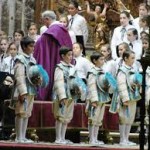 the feast of the Immaculate Conception, with a special ritual known as los Seises (the dance of six) in front of Seville’s Gothic cathedral in which not six but ten elaborately-dressed boys perform a dance with intricate movements and gestures which is very moving to watch.
Most homes have a manger with carved nativity figures around which families gather to sing carols, dance and play tambourines. The cow is honoured at this time as it’s believed that when Mary gave birth, the cow in the stable breathed on the Baby Jesus to keep him warm.
On Christmas Eve, or Nochebuena, families rejoice around their nativity scenes and eat the traditional Christmas treat of turron, a kind of almond candy. Tiny oil lamps are lit in homes, and after the traditional Midnight Mass and Christmas Dinner, streets fill with revellers dancing the special Christmas dance, the Jota, to the sound of guitars and castanets. The words and music to the Jota are said to be hundreds of years old.
Tradition has it that gifts are brought by the Three Wise Men on 6 January. It is believed that the Magi re-enact their journey to Bethlehem every year at this time and children leave out shoes filled with straw, carrots, and barley for their horses. Though all of the Magi are revered in Spain, the children’s favourite is Balthazar who rides a donkey and is the one believed to leave gifts.
If you want to get more closely acquainted with the language and customs of Spain, a good place to start is with our Private Spanish lessons, provided at your workplace or home throughout London.
 language to have contributed to the development of modern-day Spanish. It’s also significantly influenced by Arabic, thanks to the long-term Muslim presence in the Iberian Peninsula between the years 711 and 1492 AD. Loan words from Arabic began to appear in Spanish in the 8th and 9th centuries as the number of speakers of the language increased, but the influence of Arabic peaked during the Reconquista, when large territories where large numbers of people spoke Arabic or Arabic-influenced local dialects were recaptured from their Moorish rulers. This was a period in which many Arabic words and their derivatives were absorbed into the Castilian language. One result of this is that Spanish often has both Arabic and Latin derived words with the same meaning, such as escorpión and alacrán, meaning scorpion. The Arabic versions are often favoured in areas which fell under Moorish rule for longer periods.
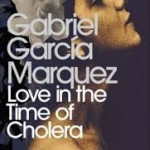 Cervantes’ immortal Don Quixote de la Mancha, published in 1605 and considered to be the world’s first modern novel; the poetry and prose of Federico García Lorca, who was catapulted to fame posthumously after his murder at the start of the Spanish Civil war; through to modern classics like Love in the Time of Cholera by Nobel Prize-winning Columbian author Gabriel García Márquez, and the highly popular works of Carlos Ruiz Zafón. Spanish literature is truly magical.
 courses purport to have you speaking any language fluently in no time at all. Can it really be so easy? Well, in most cases the answer is no, though they can be a useful means of practising what you already know of a language and helping to improve your vocabulary.
 commonly called in English, so in this blog we aim to answer that question. To do so, we need to explain a little bit about the origins of Spanish as it is spoken today.
 they’re actually not-too-distant relations. They share the Latin alphabet for a start, which is a great foundation for any English speaker who wishes to learn a second language. What’s more, did you know that 30% to 40% of English words have a related word in Spanish? This is great news for students as words which appear and sound similar as well as having a similar meaning – known as cognates – make the job of learning and remembering the new language so much easier than learning a language like Chinese, for example, which has very few cognates in common.
 including Velázquez, Goya and Picasso. It is, of course, strongly identified with music and dance. It is also famed for its diverse architecture, which ranges from Arabic to Gothic to Modernist, with Gaudi being perhaps the most famous in the latter category.
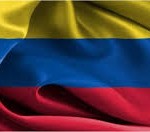 Of all the many countries in the world where Spanish is spoken as the main language, Colombia is considered to be the place where you will hear the clearest spoken version of the language. What people are really referring to is the standard dialect which is spoken in the capital, Bogotá, and on the country’s TV. It’s renowned for being so clear because the accent is quite neutral, making it easy for anyone with a reasonable grasp of Spanish to understand.
 anywhere in the UK, opportunities for Spanish conversation probably don’t present themselves every day. You don’t want to spend all your free time with your head in a text book or listening to an audio language course, so how can you practise your Spanish listening and comprehension when your classmates or tutor are not available?